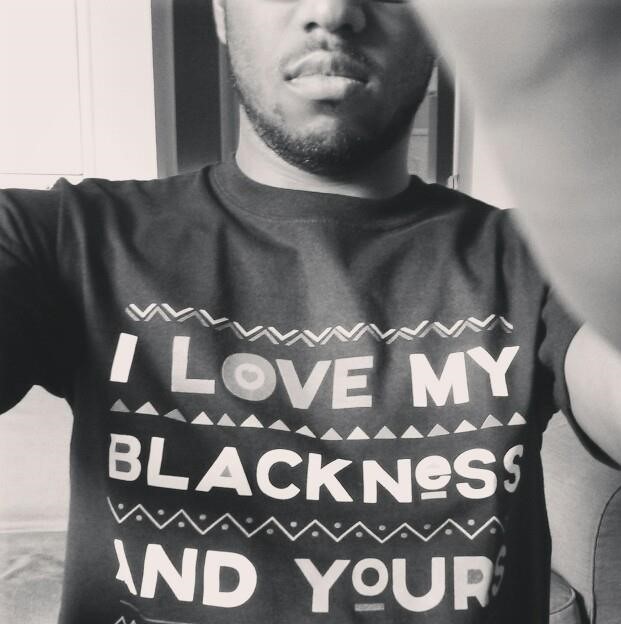
I was born Black. I walk Black and I talk Black. I live and breathe as a Black man every moment of my life from dusk ‘til dawn, 365 days a year. The construction of what it means to be Black and encompass blackness is sometimes a difficult and peculiar conceptualization to grapple with. Blackness is neither limited nor restricted to a precise dimension, it exists well beyond a spectrum in a plane of ever-expanding multiplicities and diversity but in reality it is not always that clear. If I am black, how do I know that I am Black? What makes me Black? What makes me a part of the Black community, the black race, culture and a drafted member of the Black people?
The answers were not always obvious and admittedly these are still critical questions that require continuous examination and understanding. Throughout my life I grew up with the struggle of not being ‘Black enough’ or “really Black.” As if being Black was something precise, concrete and tangible that you could embody in one moment and then fail to do so in the next, often resulting in a distancing from your own personhood or from the social group at large. At the time it meant something to try and be rather than be a part of who I am. “You read bruh? Why do you read? Reading is for white people!” The dissonance only continued to develop into more putative perceptions of my identity and character. It however was not always quite as overt and would reveal itself through subtlety.
I was embarrassed that the album “Hybrid Theory’ produced by Linkin Park was my favorite album for being truly Black meant only enjoying Rap and Hip Hop. I loved to learn and enjoyed my education including reading or writing poetry and short stories. Although I did not understand why at the time, I was not hounding after the ladies in my classes and corridors during my adolescence. I was introverted, quiet and reserved which conflicted with young men’s expectations of expressing black masculinity. I was a terrible athlete and did not care much for active competition. I was gentle and valued compromise, peace-making and non-violence. This was frequently expressed with my distaste for fighting or acting ‘thuggish.’
It became clear that somehow I could not be myself, belong to myself and also be Black. The distance grew so much that I was angry, hurt and resentful until I no longer thought of myself as Black. I was not suddenly white, Asian, Hispanic…etc. nor did I want to be. I was black, just not Black. My education of Blackness and of Black, Brown and African-American History was greatly limited and restricted. Although I was cognizant of historical and contemporary violence against black bodies and cognizant that the destruction of black bodies were often racially and prejudicially motivated I still was not truly aware or conscious. I was not, as mainstream scholars and political conscious activists frequently refer to as ‘Woke.”
I did not have any substantial education on white supremacy and white privilege and so I thought little of my peers inquiries about my [lack of] apprehension about beginning my first year at my severely diversity impaired university. In fact I figured that it would not be quite that different than anything I have typically experienced. Essentially, growing up within a predominantly Black community my inherent blackness did not matter, it was the character not the color. It was my character that led me to feel confounded and rejected from my within own community. My blackness was rarely regarded as legitimate blackness so why should I expect this same blackness to be regarded any differently anywhere else?
I had no comprehension of minstrelsy when a student in my dormitory confronted me with his Halloween costume in which he proudly proclaimed: “Look, I’m just like you!” I had no words when I asked for assistance from my fellow students on our group forum and received the nasty response: “We don’t like your kind here.” Nor did I give much notice to the obsessions with my hair, the uncomfortable glares directed towards me whenever race was mentioned in a class, when I was attacked my first time going out to the bar and I remained silent during casual conversation about black people victimizing themselves and how I was asked to share my experience growing up with bars on my windows (evidently untrue). I remained shamefully naïve and silent when a professor would call out the names Andre or Dominique off the roster and look to me to respond. I could go on and on and continue listing off the dozens of micro-aggressions that have occurred, but I won’t.
Something began to stir the pot for me on February 26th, 2012. Trayvon Martin, a young unarmed black man was gunned down by George Zimmerman in Sanford, Florida. Trayvon Martin was murdered and the only justification that had been given was that he was walking down the street wearing a hoodie which was evidently enough information for him to be considered suspicious and threatening. He was found to have been on his way home from the convenient store his pockets full of candy. Trayvon Martin was nearly my age when he was murdered. I remember sitting there in my own hoodie, snacking on some sweets reading the immensely disturbing news. Even though, I felt heartache and distress about the double standard and the ridiculous backlash against Trayvon and the swelling support for Zimmerman I still had not realized that I was Black.
It wasn’t until approximately two and half weeks later that I had finally reached enlightenment. In my English class we had been critically analyzing the literary works of Frederick Douglass. In particular we examined his speech Douglass “What to the Slave is the Fourth of July?” It was a magnificent piece. It was single handedly the most inspirational, yearning and powerful piece of rhetoric I have ever read. Within this unit of studying his speech we read an excerpt from a book or diary that was written by Thomas Jefferson of which I currently do not recall. The entire excerpt was outrageous and disgusting. Jefferson wrote in detailed language his perception of black men and women; casting judgmental and demonizing assumptions about their bodies, minds, abilities and made reprehensible remarks about their “sub-human” nature. The pain that I felt reading this excerpt was tremendous and what hurt most about how racist, demeaning, prejudice and heinous his words were…was that I had no idea what that pain was.
I had no idea what it truly felt like to face racism in its purity. I had no idea what physical, emotional and psychological damage slaves had to endure. There was no empathy that I could have given hundreds of thousands of people that would have done their pain any justice. Even less empathy for those who inflicted the torture upon them. Furthermore, the pain that came after [for me] was the ultimate realization…that these vile words were in reference of my ancestors. The root of my very existence today. All of my great grandparents, my grandparents, my uncles, aunts and cousins. My siblings, my friends and myself. There was no true reasoning or rationalization to justify his core values and belief; it was simply because of the variety of hues, colors and shades of the melanin within the skin of my people.
Nearly in tears, my gaze turned away from my professor and onto my colleagues in which surprise and rage overtook me. I was appalled that these other [white] students were not listening. Several students were on their laptops chatting and scrolling on Facebook, watching YouTube videos and sending emails. The student beside me was literally distracted with online shopping. They were talking to each other in small groups, texting on their brand new iPhones or asleep. There were students who literally had earbuds in during the presentation. Obviously they were not quite as moved as I had been and in my opinion could have cared less.
Much became clear to me in that moment as I sat there surveying them and for the first time ever in my life, did I truly realize who I was sitting in that room surrounded by them. I suddenly felt far away, isolated, alone and misunderstood. I realized that they had no idea that this history was just as much theirs as it was mine. That it was their ancestors, their great(s) grandparents, grandparents, great aunts, uncles and cousins in which their existence has been rooted that committed atrocities against my own. It was their heritage that provided them with wealth, education and privilege and though these students may not have been personally responsible, they showed me in that moment that they were not innocent. They sat there and refused to learn and re-learn, refused to be educated and care about the structures, systems and institutions that have been established within our society. They did not care that the man who helped found our country founded it on the principles that took Trayvon Martin’s life and would eventually deny him justice as it does on an astonishingly regular basis. Why should they? They were white.
I came to understand in that very moment, staring at their whiteness that I was Black. But I was not Black independently in fact being Black was truly some sort of an illusion. It became most clear that I was only Black because they were white. My blackness only exists because of the existence of their perception of whiteness: of white privilege and white superiority. I have not been satisfied ever since that pivotal moment in my life. I had hundreds of questions to be answered, my curiosity stretched as I thirsted to make sense of more and to understand further. My anger and fury has yet to fade but this liberation also sharpened my mind and focused my attention. I was awake.
Despite the caution from my parents, peers and colleagues and regardless of the triggers of historical understanding and knowledge and my experiences growing up in my community it took me 18 years to become conscious of my blackness. I sometimes wonder if Trayvon Martin had known that he was Black. Ironically, no Black person or any other person of color (in the media or otherwise) managed to teach me that I was black. It was white people who had managed to teach me. I understood blackness, racism and racial injustice much more clearly because of white people. Because of their micro-aggressions, their racist slights and prejudiced comments and because of the “obvious” divisionary line of privilege they were always so eager to draw between me and them. In an almost odd kind of way, my Black brothers and sisters enlightened me about my character and those who were white, enlightened me about my color. I recognize the complexities within that statement and I still am caught up in the irony today but when you seriously consider it and think about it, it really isn’t that ironic at all.
I hope that in the future we can further analyze and create broader discussion on blackness and the pros and cons of its social construction while developing meaningful ways to engage while striving toward greater social and racial justice. It is a testament of self-empowerment and growth in awareness of the structural injustice(s) and being conscious of the variable preambles of our contemporary society. I inquire that we raise a conscientiousness and confront ignorance by asking ‘When did you first realize you were Black’ but equally as significant, taken my experience to ask a more critical question: When are they going to realize they are white?
 The Wayward Scholar
Leave a comment