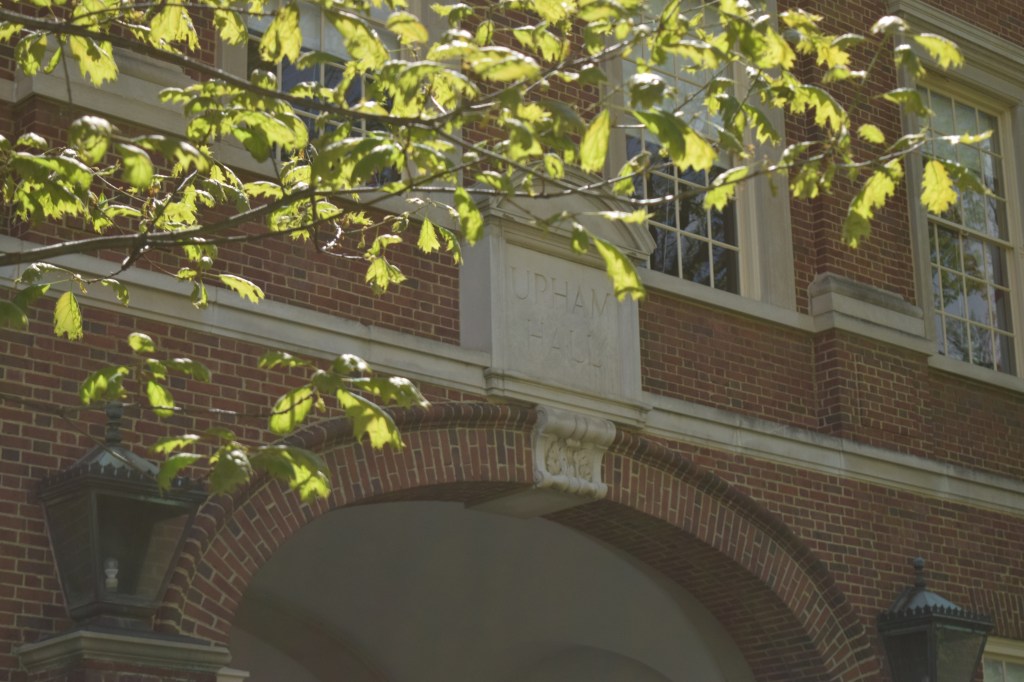
For many graduating seniors the feeling of jubilance, excitement, great relief, pride and joy is accompanied by frivolity and celebration of completing a significant milestone in our lives. In addition to the relief and joy, one cannot escape a sense of confusion and also a sense of anxiety with the proverbial question mark looming in the distance. What happens after college? What do I do? What can I do? This of course, is not an accurate narrative for every college senior or college graduate but it certainly describes me. My colleagues suggest that I select one of two paths that they have chosen for themselves. Apply for jobs and work in areas of my desired profession or continue my education in graduate school. These are very reasonable (and obvious) suggestions. Additionally, this past week I was approached by three of my professors either after class, during office hours and on the street. Earlier this year, I was also contacted by other university members on different occasions. Each of them offering the same advice and encouragement. I need to get my ass into graduate school. The general argument that has been following me around since my childhood is that I have an enormous volume of potential, unique ideas and favorable strengths that could be largely beneficial in any number of areas of expertise with proper application. That I should continue going forward through graduate programs and grab hold of every opportunity I can until I reach the top of the mountain. Which sounds promising…but what if I don’t want to go to graduate school? I’m torn.
On one hand there is a level of personal and familial prestige that I could achieve by continuing onto graduate school. I am one of less than a dozen souls in the entirety of my family history to attend college; with even less attending a large university. This includes those family members and cousins whom are currently in academia presently. The numbers are fortunately likely to increase with youth having a positive possibility of attending college. If I went ahead to graduate school I believe I would be definitely a minority in my family with an education that high, one of three at the most and additionally would be the very first to pursue (and receive) a Doctorate or Ph.D. if I chose to do so. My educational success could at the least be an example for future generations that they can achieve anything they want to and that an education they desire is never out of reach. This is especially significant and empowering for black boys and black men in which our world largely attempts to illustrate as uneducated and illiterate.
On the other hand, I have some serious grievances surrounding the education system and the construction of higher education. The structure of the classroom and general curriculum doesn’t make quite as much sense to me. For starters, I am allegedly paying tens of thousands of dollars and assimilating debt for the rest of my life for ‘higher’ education. Presumably or at least I expected that this education would be somehow transcendent of my public education that largely wasted our time on standardized testing or prepping us for becoming victims of the prison industrial complex. I admit that at first my college education did in fact transcend this secondary education and completely met my expectations.
I don’t remember when but at some point I ceased learning; the classes became mundane, predictable and busy. The students seemed only concerned with their grades, meeting expectations on rubrics and professors appeared obsessed only with assigning points and interested in creating an army of experts in summarization. Where was the critical thinking? Where was the critical examination? Why was I the only one interested in asking the hard questions? I cannot count how many perpetual papers or quizzes that I have taken asking me to introduce myself or practicing if I can use my laptop or to show that I know the proper classroom and college etiquette (a quiz won’t reinforce or curb this behavior anyway because it’s all common knowledge and has been taught to each of us since kindergarten). I found myself assigned so much work to complete on a daily basis that I no longer was learning any of the material. All I was doing was writing countless papers, summarizing readings and articles (which were typically summaries themselves) while paying tens of thousands of dollars for permission to do so. It became a rarity that I had any time to actually ingest much of the material and whenever I performed poorly on an assignment, quiz or exam there were few opportunities to get the correct answers or any resolution. The point of being in college became translated as an endurance challenge because at the end of the race there is no guarantee that anyone would actually win anyway. The degree is not some true ticket to an all expenses paid future, especially with the rising value of education.
This is relatively similar to my next understanding as higher education as a filter. The grades, the numbers, the points, rankings are designed in a manner that only allows the recruitment of few populations of students and manages to retain them. What I mean by this, having high ranks, points on these arbitrary measurements and scales does not make one more qualified or more intelligent than another. All that it proves is that these students have higher endurance and are really good at school. This is the fact of causation versus correlation; the two may appear to match (qualification and grade point average) but they do not necessarily compare. I feel that not only do many people realize this and acknowledge it but regardless we accept it as a fact of life and continue the cycle. I believe this cycle continues because it serves a far more nefarious purpose that I would rather not contribute to upholding.
As it appears from my perspective that the system is set up that it almost encourages students to embrace limitations in education. Only willing to learn what is placed in front of their faces rather than going beyond what they are taught in a classroom. We literally have set up a culture where nobody knows or understands anything unless it has been literally shoved underneath their nose for them.
These persons who show no initiative, critical thinking or great intellectual, talent, ability or skill are prided and valued higher than others because they were awarded a piece of paper for being hardly exceptional. They “earned” it by shoveling out tens of thousands of dollars for facilities, diligently (probably not) wrote several novels collectively of summaries for their college career and endured tests, quizzes and exams loaded with information that many students don’t retain for long. It’s not that I think school is pointless. Simply, I think that structure and emphasis on it’s importance is frankly, silly. Who are we helping? Who was this system created for? The fact that I can major in Medieval History and end up as an high school English professor represents my point and questions how useful is the knowledge we are learning? If we are not learning critical thinking skills, engagement skills or even how to find success in our fields of study, then what the Hell are we doing?
This makes me question how much does school and higher education matter? How much do resumes, cover letters and interview training matter? I don’t deny that these methods and systems are significant but perhaps we overemphasize the importance. It parallels my suspicions that perhaps skirting graduate school is permissible for those intellectually or more socially savvy. Why pay to do, what you can do on your own? Read all the books (past and present), articles and engage with others in dialogue and discussion. Attend national and international lecture series, sociopolitical or socio-economical relevant conferences, meetings, events and congregations. Gain experiential perspectives in addition to academic perspectives and utilize creativity and innovation. If the politics of networking, following your passions, maintain perseverance, open-mindedness, flexibility and introspection are vital, these skills should theoretically facilitate carrying the burden of independent growth.
If one has all the qualifications, can demonstrate scholarly proficiency, academic rigor, intellect capacity and exceed expectations in the performance of one’s duties and responsibilities then shouldn’t they receive the honors and the career opportunities? There are multiple passages to take and they do not all have to be difficult, what can be learned from the journey can be immeasurable. If this does not yield success and instead customs failure rather than allowing one to claim prestige in personal success, for the sole reason that they do not possess a degree. I would argue there is something seriously flawed with the current system. How can I participate in a system and a structure where the flaws indefinitely filter out brilliant minds? How do I negotiate remaining true to my values and true to what I stand for without compromising my own existence and future?
How can I place myself in a room that reeks of elitism and sit round a table with some of the greatest minds and scholars with the proverbial door shut and locked behind me? Joining in the chorus that sings that all those who are worthy, whom work hard enough, fight hard enough, want it badly enough and are essentially intellectually gifted enough will eventually find their places at the table in this room, closed off and separate from the rest of the world. How can I sing along knowing that outside that door there is a wilderness, a desert, oceans and towering iron gates guarded by trapdoors, landmines, violence, corruption, poverty, illness and systemic and institutional barriers all working in tangent for the only purpose of keeping people out of that room? Am I effectively contributing to progress while participating in hiding the glorified key to the that door in the depths of a labyrinth in which there is no map nor guide. Following up with declarations and expectations that those who are truly “worthy” will shine through? Without acknowledging the fact those who make it might just have stronger stamina or endurance and in reality lack the intellectual capacity to thoughtfully contribute?
How can I sit in that room fully aware that there is a young child or an adolescent who has potential and genius but has limited or no means to get past those barriers? That their future despite their intellectual, critical thinking skills and perspective is worth a damn because they are in a caste system that says the authority over their own lives and authority of their dreams is predicated upon a piece of paper that you must first pay for?
They are told to sit completely still, head down, feet together, hands folded on a desk only to face the sting of their teacher’s ruler on the back of their neck when they attempt to shift. When they dare to see beyond the miserable words scribbled on the blackboard in front of them and ask questions more complex, thoughtful and inquiring about the text or the world around them. When they dare to dream abstractly and resist the shackles of monolithic curriculum’s they are labeled as having conduct disorder, mood disorders or ADD. When they are presented models over and over again that the only way they can realize their dreams is through undergraduate school or graduate school that simply filters them out of the screening process. The answer is not easy and there are major complexities, some of which do not directly impact myself. But as an advocate for social justice, I do at times feel responsible for. The world is overwhelmed with gray, there is rarely black and white and no matter how much black you add to the mix or how much white, you will always get gray. A friend recently advised me that although valuable, avoiding the oppressive systems and stepping out and away does not make the world any less gray either.
I often feel validated in my perspective and reservations of attending graduate school because of a quote by Ta-Nehisi Coates in his novel Between the World and Me. He goes to say “I wanted to pursue things, to know things, but I could not match my means of knowing that came naturally to me with the expectations of my professors. The pursuit of knowing was freedom to me, the right to declare your own curiosities and follow them through all manner of books. I was made for the library, not the classroom.” Coates criticizes the education system several times throughout the book and some of his points are highlighted in my own personal perspectives as well.
One of my professors that has been encouraging me to consider graduate school more seriously also articulated the point that, Coates, and many other brilliant thinkers and writers, have taken advantage of the education system that they may often detest and talk poorly about. These individuals despite their intense criticisms of the education system and structures each attended graduate school, that had ultimately contributed to their current success.
Which is a perfect example of gray. Is it righteous and appropriate to participate in oppressive orders and remain complicit in numerous ways but also demean them? Can you bite the hand that feeds you?
I have been heavily influenced by some of these writers in my decisions and considerations, examining some of their dreams and aspirations as guides to help form my own. But what if these writers and authors, activists, scholars and politicians and workers had not actually participated in graduate school or college at all. What if this knowledge, wisdom and perspective was accessible and I read their words, admired their success and academic rigor and realized they were able to achieve these dreams without any degree? Would I be inspired? Would I be empowered and enthralled to take charge of my own fate? Would I truly forge a path less traveled? If hundreds of thousands of people decided to fight and revolt against the contemporary engineering of higher education, would we break the system? Would that system be replaced and driven without meritocratic principles? As Black Americans we have always had to create Gold out of thin air. What exactly am I betraying by embracing this legacy of spinning gold from brown sugar? Capitalism? Commercialization? Racial Domination? The American Dream?
In my studies and personal experience, I have discovered that most structures that we succumb to and rules/guidelines that we follow are illusionary. They are not actually rooted in any thing other than a reality that we are spoon fed to believe or choose to construct for ourselves. Constructed as methods of social control often targeting minorities and marginalized groups. I often hear the lame cants about how the best way to fight the current system is to work within the system. Audre Lorde once wrote “The master’s tools will never dismantle master’s house.” I personally resist against the saying working within the system. I want to break the system. I will do exactly what they are doing, learn more, accomplish more, have no degree and still get the job. Pave the way towards infinite success and embrace that good ol’ American Dream because if the degree mattered then my claims would be folly. It wouldn’t make sense that I major and get a degree in say, Russian Literature and then become a social worker or a math teacher. Or major in Physics and end up as an accountant. These things are not congruent nor exclusive to each other but they realistically happen daily.
Growing up my mother would always tell me that there is a job for everything, that people demand and require so much to function in our daily lives that there is likely a job somewhere that makes that possible. If this is truth, I figure there must also be infinite (or at least several) ways to land a job, career or profession and the road is not singular. The roads to employment, success, or happiness didn’t always require an advanced degree and I think it’s time for a reminder and also time to innovate new ways.
School for me is a trap. It’s meant to be higher education, a knowledge system, an educational institution, a school. School is for learning, for acquiring knowledge and education it is not meant to be for acquiring a job. It should be celebrated for much more than the degree.
But I’m understanding that my experience of course is uniquely my own. Perhaps, I’ve been a bit hasty at solidifying my opinion without a comparative college experience. Perhaps my selection of academic study was not congruent with my true interests, perhaps the institution that I’ve attended has a stronger value in career majors rather than liberal art degrees, perhaps my education prior to college failed at providing substantial college preparation, perhaps I’m just snooty and prestigious, perhaps I’m incredibly naïve and still have much learning to do or perhaps I simply outgrew undergraduate studies quicker than my peers and this would be precisely why I should attend graduate school. Perhaps as a minority student I could use this position to challenge and fight to change the disparities I have grown aware of and accustomed to. Perhaps my rebellious nature is getting the best of me.
Perhaps, I will eventually attend graduate school but I am not sure that I will pursue graduate studies to create and form a career. I think I’ll pursue graduate studies to follow my passions and follow my heart as I am often told is what we should all do. My passion is learning and my passion is gaining knowledge for knowledge’s sake. Perhaps, I will follow this passion independently and acquire as much knowledge that I am able on my own, to frame my own thoughts and seek answers to all of my questions and consume as much knowledge until I can no longer answer those questions on my own. Ultimately, I have to make the decision for myself but until then I am not giving up on the idea that we can break the system by banding together and shedding light upon a path to success that does not inherently require higher education, as the famous quote from Ralph Waldo Emerson states: “Do not go where the path may lead, but go where there is no path and leave trail.”
 The Wayward Scholar
Leave a comment