[WARNING: ‘Spoiler Alert’ there may be some spoiler’s mentioned throughout this article]
Netflix has launched the new hit series, Stranger Things, jam-packed with nostalgic imagery and rhetoric while filled with mystery that is reminiscent of a child-like wonder in science, curiosity and fantastical monsters. Enabling the show to move to the top ranks on Netflix in no time as well as no doubt igniting a new appreciation of Dungeons and Dragons with its viewers.
While enjoying the show my sociological mind could not help but identify some intriguing reflections of social roles, behaviors and connections between injustice, fairness, policing and overwhelming desires to set things right when they go wrong. Through introspection and some short discussion with peers (also fans of the show) I’ve concluded that there are in fact some interesting correlations between police brutality, our individual and collective inclinations and the potential of these intersections to influence a larger trend in our working society.
Recently, a bright light has been shown on the distrust and disconnection between law enforcement and communities of color. The current climate in our nation has been increasingly tense as state-sanctioned violence, police abuse of authority, police brutality and discrimination against Black Americans has become more and more recognized in the public eye. There is no doubt some contesting ideas and philosophies of the best resolution(s) to these tragedies that disproportionately impact people of color. Although contesting ideologies may inhibit change and restoration, perhaps our more covertly congruent ideologies and values influence progress more than expected.
So let’s talk about Hopper. Hopper is the apathetic, no nonsense police chief of Hawkins PD whom is dead set on solving the mystery of Will’s disappearance and the odd events unfurling throughout town. Hopper is the bad-ass, tough cop that embodies all of the traditional hegemonic masculine qualities that we’ve come to love in male lead characters. Qualities including emotional detachment, excess rage, long brooding silences, assumed sexual promiscuity, and misdirected aggression and violence; all expressed with mystifying swagger enveloped in a tragic backstory that establishes him as one of the most ironically likeable [adult] characters in the show.
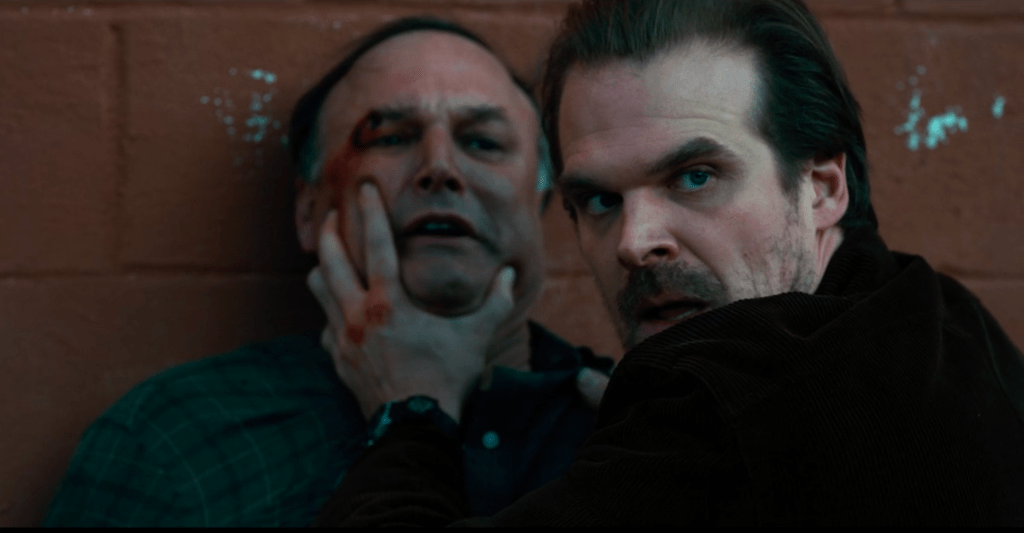
In the quest to uncover the truth Hopper demonstrates a choleric temperament throughout the show particularly during an interrogation with the corrupt State trooper whom is obviously withholding information about Will’s disappearance when at the bar. After quickly downing his drink, the scene cuts to Hopper striking the trooper several times behind the bar and demanding more information from him. Beaten and bloodied the trooper provides Hopper with some answers before managing to flee potentially for his life.
It is important to understand exactly why this representation of Hopper is demonstrative of how the American police force realistically operates in our country. Instead of responding with aggravation, anxiety or reasonable distaste for this methods. I found myself applauding his efforts. In fact, I would guess that I am not the only one. I believe that many of us were likely to applaud him, we cheer for him despite his verbal and physical assault of a couple of characters in his quest for the truth. What would be thought of as inappropriate and unreasonable actions for any civilian is celebrated instead. He is not the villain and could never be the villain, he is our Hero. How many of our real life or fictional heroes would be thought of and celebrated as heroes if they had not taken that extra step over the line to violent assault someone or even commit murder on the behalf of the ‘greater’ good or ‘the greater collective.’
In fact, in the bar scene after the trooper exited with a pretentious sneer, I knew exactly what would happen next. The predictability of what happened was not just in the story line or the context but in how much I wanted it to happen. I willed him to beat the snot out of him, to pummel him for answers, to do whatever it took to save Will and it was all O.K because it was in the name of justice…right? Had he not done so, I wonder if I would have been disappointed.
I argue that at least some of the trouble with American policing is more covert than overt racism, masculinity and glorification of violence. We assume that when an officer steps out of line and shoots an unarmed Black man, murders a child in the street or drags a young girl across the floor it is because they are acting independently. However, police aggression and police brutality is constructed into the very fabric of our democracy, rooted in the assumptions and expectations that freedom can only be fully enforced with Might. This is a perfect example of what it means when someone says that most – isms are systemic and structurally founded. Those sworn to protect and serve in this context are never out of bounds and rarely cross the line. Law enforcement are the keepers of our historical and contemporary democracies. They protect our collective desires, hopes and dreams and serve our ambitions and our collective perceptions of reality. Much like Hopper served our desire to do whatever it took to solve his case and protect and serve his community. It is difficult to view someone as doing wrong when no matter what their actions are; it is always perceived as right. Our Hero cannot ever become the villain.
While I criticize our collective complacency I also consider how one may argue that Hopper is just doing his job, that he has good intentions or to imagine if it were my child or loved who were missing under these circumstances. But that is exactly my point. Imagining that it was my own loved one missing, I find a failure to empathize or express as much sympathy but simultaneously I recognize the bitter reality that it could also easily be my own child or loved one on the other end of those fists and rarely for a righteous reason.
Someone, somewhere wiser than me rightfully deduced that our local communities and government at large fails to make any rightful ‘reform’ policies, deconstruction of policing culture and upset because law enforcement simply carries out the will of the American people. Movements such as Black Lives Matter are not only questioning law enforcement but questioning America itself. To dare and accuse an officer of doing wrong when his intentions were to do right, is to personally accuse every American individually. Every accusation is taken personally and every disagreement is an act of treason because every single person has some input whether they realize it or not. It is the Will of the People, that provides advantages to some while disadvantaging others. It is the Will of the People that enforces surveillance of low income communities and targets black bodies to control or destroy. It is the Will of the People that overtly administers violent policing to people of color and covertly consents to violent policing of everyone else.
Hopper’s character shows the trouble with American policing and reflects the greater perceived trust than distrust in law enforcement. That even when we lose faith and confidence in our own government; our men and women in blue will always be there to stand for us and protect us and serve. So the question is, how much of our own liberty and how many of our lives are we willing to surrender to maintain the illusion of our own liberty and our right to life?


 The Wayward Scholar
Leave a comment