Our imaginations and creativity are by far some of the most powerful weapons at our disposal for shaping the future. As technology has increasingly become a daily factor in our lives and with access to the thoughts of anyone across the globe with the click of a button, it can be easy for our conceptions of what is plausible to be dominated by ideologies that have already been invented for us.
Although, our imaginations may be expansive we are often limited in these imaginations based on the assumptions of our geographic location, historical time and social location. I cannot decide whether it is more irony or a paradox that our imaginations are heavily influenced by what institutions and structures dictate for us.
Afro-futurism, in which many argue is where the genre of Black Panther thrives, is the aesthetic philosophy of re-imagining blackness, race and culture especially within the realm of science fiction. Although, I thoroughly enjoyed the film for a host of reasons I am disappointed and yet unsurprised in the failure to imagine a true future of black liberation.
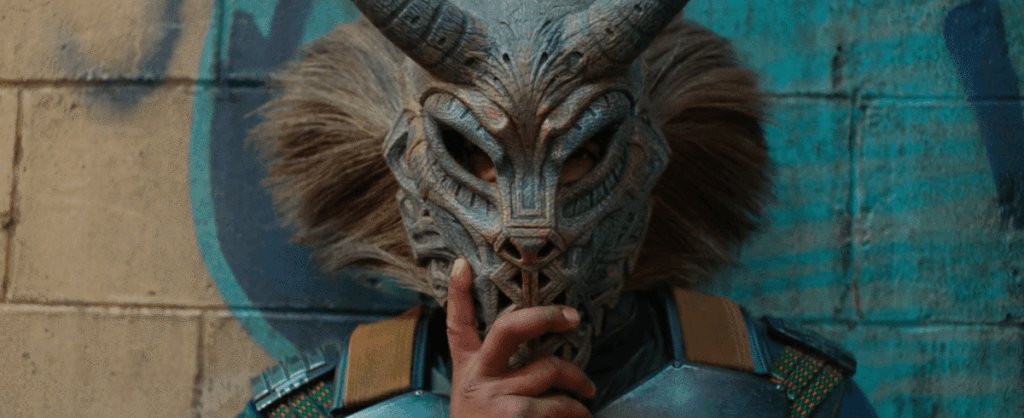
Erik Killmonger, presumably the villain in the film, plays the role of the antagonist with his entire persona as a complex, full bodied representation of what many black scholars and intellectuals would declare the ‘American black man, or the American negro.’ This specificity is significant for the history of black men and women in America creates a unique identity in the landscape of America. An identity that exists without truly living but instead continuously surviving in a caste system, disconnected from any history and heritage other than white supremacy, ethnic cleansing, slavery and struggle.
Current school systems arguably fail to even adequately educate black and brown people about our most recent history let alone histories from the motherland. Killmonger is depicted as a raw Black rage, having been consumed so thoroughly by white institutions that upon being spat out, his own imagination was limited by the tools of power, control and domination presented to him.
His fury and rage relied upon asserting power of male supremacy, misogyny, classism, homophobia, fat phobia and others.
Although, highly problematic I wonder does this hi-jacking of his mind and body truly make him a nemesis of Wakanda? Does his fury and inner motivation to de-centralize power and provide a pathway for those who are suffering to take matters into their own hands where-ever they may see fit?
His anger demonstrated how his existence in a colonial world has poisoned his ability to acknowledge his own humanity, those in Wakanda were free and liberated having never known any form of bondage. Therefore, Killmonger striped of dignity, grace and humanity could only be a monster, but then aren’t we all monsters?
Being black is predicated upon the assumption that our entire existence has been subject to such severe violence, domination and shaped by colonialism that we exist beyond humanity.
Blackness is the child brutally torn from its mother [land] forced into labor, lynched, castrated and forced to watch as colonial powers raped and spat on her for centuries. There is one thing to have been raised in an Afrocentric culture and another to meticulously hunt and fight through a world of shadows and ghosts to find it. Why was Killmonger then turned away from the only powers in the world capable of healing him?
Even in an entirely afro-futuristic, black owned world, a world controlled by black structures and black institutions we are considered so irreparable that compassion and empathy still eludes us. With access to presumably incredibly forward thinking, progressive technology and attitudes we are still unable to envision or create a future in which black bodies are not disposable. Wakanda did not know what to do with Killmonger for when it came to find restitution their options seemed to reflect upon either imprisonment or death.
Wakanda could not/would not provide him with true citizenship on the land that birthed him or grant him acceptance as a lost child, abandoned and neglected only needing the love of his people and the freedom of his people to prosper.
I ask, what exactly was his crime?
He carried out his duties and brought justice for his people that had craved it. He proved his heritage and his birthright to have a seat at the table and challenge the throne. He attempted to destroy this table and vowed to expand so going forward there would always be seats for each of us. He followed every Wakandan law, order and custom to cement his ascension to the throne. He utilized those powers as King to employ weapons and aide to his brothers and sisters across the globe to rise and take back every country and continent that they built upon their backs. Is this not revolution?
T’Chaka had passed on the wisdom to T’Challa “It is hard for good men, to be King.” Was Killmonger then undeserving of the throne and only deserving of destruction because he wanted to be a good King and aide those beyond Wakandan borders? (In which T’Challa ends up doing anyway after Killmongers death).
T’chaka and the many rulers before him were misguided cementing the tradition and ideology that the unflinching disposal of one another to maintain a utilitarian order was necessary. Even going to the lengths of raising an army, the [bad ass] Dora Milaje to protect the throne, these collection of ideologies and abstract values, by any means necessary including destroying other black bodies to maintain these illusions ‘for the culture.’
Killmonger followed in the footsteps of this Wakandan heritage and in the name of tradition, from both worlds in which he reigns, that safety and peace can only be achieved via control, dominance, manipulation and destruction. He is no villain for attempting to juggle the life that he has known while trying to assimilate into a world in which he could only imagine in his dreams.
Wakanda presumably thrives in a world untouched by white imperialism and white supremacy and does not operate from any conception of race or ethnicity. Although they existed without colonized perceptions of themselves, this does not mean there were no adopted colonized perceptions in how they viewed others.
Killmonger’s rage, desires, dreams and experiences were specific and to Wakanda they were strange, unfamiliar, and perceived with suspicion and dangerous. Killmonger arrived from the outside world as a distant cousin, confusing, misguided, young and stripped of humanity leaving him an empty shell of pain and rage. He was positioned as being a monster and was seen as what the rest of the world had marked him as his entire life, Black. As is the only crime any American black man has ever been guilty of.
In the genius of beautiful, Afro-centric Wakanda, the blackness that we know and love should be kept on the fringes and outside its borders. Killmonger’s anger originates from a deep betrayal and refusing to understand how in a white world that destroys everything that he loves; his own flesh, blood and reflection would be the first to take away what was most precious to him. That his own flesh, his own blood would cast a side eye at his blackness and deny him an opportunity to live among his reflections in Wakanda.
“They haven’t found us, because they haven’t found themselves.”
In the genius of Wakanda, why can freedom and liberation only be achieved in death?
It does not appear that black lives are valuable and matter, even in our wildest dreams. For though my roots are in Wakanda, I am not Wakandan. I exist here, in America as an outraged black man enduring daily injustices and desiring change just as much as Killmonger. If an Afro-futuristic society fails to imagine ways of truly celebrating our lives and still functions on disposing and destroying black bodies, perhaps our imaginations continue find limitations in the sphere of whiteness and colonialism. Black Panther asks us to consider the question, what responsibilities do we have to one another across the diaspora and across intersections and unfortunately, with a sharp blade through the chest it answers.
When was the last time you truly took time to cherish and take care of your community? How often do we take time to celebrate the immediate community found in our neighbors? How often do we take hold of our brothers and sisters who are low, place them on our shoulders and help them reach the stars they continue to stretch towards? Do you dismiss each other over varying politics, respectability, size, age, sexuality, color or ability? How often do we dismiss each other and dispose of one another because they were not yet rich or famous, or we feared them for their audacity and radical efforts to be free?
It is within these moments of purely, unconditionally loving each other and only one another will we begin constructing a future beyond the limits of our imaginations and fears. Where we can be defined by who we are and not by our struggles. Where we can truly embrace and reinvent even our own humanity.
Until that day comes, Wakanda will just remain fiction.
 The Wayward Scholar
Leave a comment