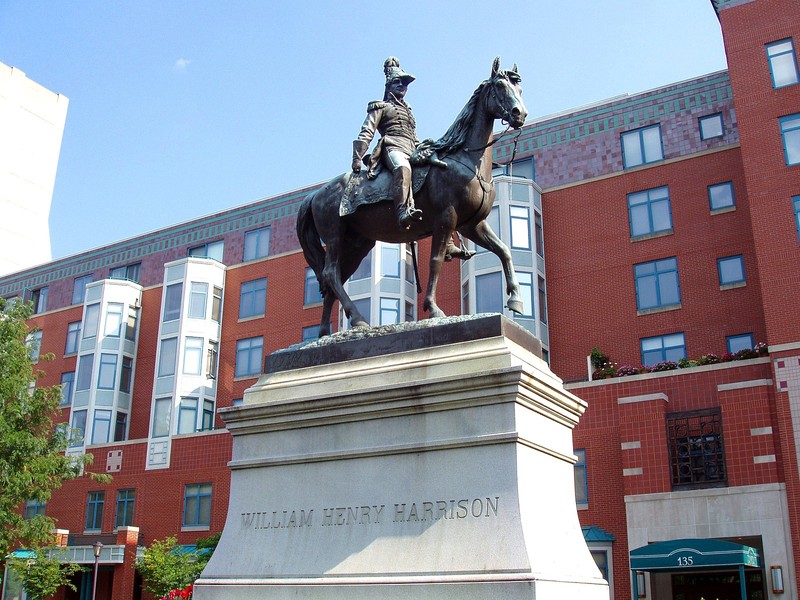

I wonder what he is thinking up there.
In Piatt Park, Cincinnati Ohio, a monument of William Henry Harrison is seated against a backdrop of a city landscape transitioning from summer to autumn. Studying the monument, I wonder how I am supposed to feel. An equestrian statue with a white man seated bronze 13 ft high in the air, you can hardly miss its presence. How are we meant to regard this figure and what should this mean to me?
I wonder what William Henry Harrison thought about legacy, honor and memorialization? Would he have predicted the controversy and the debates that would follow his name? I am curious what he would say to justify and defend this permanent residence. What exactly earns you a throne of immortality in a public park?
If the figure could speak, I wonder what his comments would be on the Charleston Massacre claiming 9 Black lives, or the Buffalo Massacre claiming 10 Black lives? What would he say about the white supremacist, white power rally in Charlottesville? The protests in Ferguson or about the 2020 civil rights protests here in Cincinnati and beyond, ignited by escalating impatience with police violence, police brutality and the lack of definitive transformations to policing. Where would he align on the murders of Ahmaud Arbery, George Floyd and Breonna Taylor? Would he support the supreme court’s rulings that challenge Indigenous and Native people’s sovereignty of their communities and land. If he could comment on the ongoing gentrification of the city. What would he say?
It may seem irrelevant to ask or to wonder what he would think. When all the dust settles, what will remain to tell our stories to those who come tomorrow about who we are today? Monuments are fixed speakers meant to educate and commemorate the historical importance of their time and their notorious contributions. Monuments are placed on a pedestal of honor to voice our most celebrated and protected legacies across the generations. We want to be brave, honest and free people who treat one another with mutual respect and dignity — is this who will speak for us?
Harrison’s legacy is most known for serving as a military officer leading assaults against and destroying a Shawnee village “Prophetstown” during the Battle of Tippecanoe as an alleged war hero. He negotiated treaties that stripped land rights from Indigenous communities, owned several slaves, indentured servants and slave traded. He would be elected to President of the United States to serve the shortest term of thirty-one days. He died in 1841 and the statue was unveiled in 1896.
When we publicly honor someone’s legacy, we are endorsing their life’s work, accomplishments and contributions. A monument to his name and in his likeness seeks to represent what we value most highly and share our most prized stories. Perhaps we dare not look too closely for fear we may see ourselves in who we idolize and build monuments to. Who do we sacrifice so they may live eternally? We love symbols, embrace them, organize our philosophies, values, beliefs around them while also attempting to argue they have no meaning.
A celebration of the life and legacy of racist violence may not represent the whole truth and complexities of a man’s character but the whole truth is ugly and foul, not bronze. As I study this monument and recall his legacy, he does speak. He speaks of those violence(s) of the past as if they were in the present. He speaks of terrors of his time, echoing today and he speaks undisrupted, undisturbed, out of touch, out of time and yet he persists. He publicly declares the continuation of a colonial thinking and heels set into granite stone promises to endure in the present as well into the future. Here in Cincinnati in Piatt Park, he continues his ride, he continues to speak and for many he continues to symbolize anti-Black racism, colonialism and capitalism.
Monuments serve as testaments approved and funded by the State to endorse ideologies that disadvantage and sanction violence toward our most vulnerable communities and populations. These models serve as a political subject and this can fail to accurately educate us about the full impact of our shared histories and conditions. We must ask ourselves, should we demand the whole truth or accept our current stance in the shadow of lies.
The symbolism of public monuments should represent the culture and values of the city and all of its people. In recognizing the history and the significance we place on the symbolism of any artifact we may collectively learn to own and face our truth. This honesty allows us to do the work to create a society and culture that is just, and does not demand the governance or domination of another to function. I imagine then we won’t desire symbols to commemorate violence nor would we need symbols to signal and remind us to uphold the promise of justice, respect, equity and equality for all.
This debate of monuments has been on going across the last century. The “Lost Cause” campaigned to build monuments of Confederate soldiers after losing the war to the Union. It was a campaign to disguise the true causes of the Civil War. It was an attempt to disguise that oppressive institutions could successfully be disrupted and we are all closer to being free when we recognize our power to resist and demand our rights are honored. The idea of permanent public monuments and memorials were not common until post-Civil War because of this type of campaigning. Even if we are to continue to build memorials and debate the future of monuments; should we build them to honor those who commit violence against other peoples, communities or nations?
These conversations are occurring across the globe where monuments or statues mark and occupy space. The history of our nation has already provided the accounts at length to acknowledge that we could teach the history without placing people in positions of honor. There’s an irony that these monuments carry legacies of occupying space and this promise does in fact endure as they continue to occupy physical space and over represent the space in historical memory – and therefore this conversation is not a new one.
We must learn to understand that monuments are symbols of the State and therefore are inherently violent and opposition to an organized and free society. So, this is the struggle, the undemocratic consensus that erected the memorial could be undone by democratic practice. If not, We the People, should toss a chain around its torso and symbolically test the values. Does it truly hold firm and steadfast, are these values truly enduring? Let every oppressive monument be removed or let them fall and let justice stand.
Monuments have become sites for the political struggle on race, capitalism, colonialism but most of all the preservation of history, memory and truth. We can reimagine public spaces without monuments and feel comfortable this could signify the current times and be a public mark of a free(er) land, a land being decolonized and a people moving closer to liberation, fully realized rights, access to justice and quality of life. The space could be utilized to expand on current education, resource, community service events or become a public memorial space where residents can display temporary memorials for lost loved ones.
Frederick Douglass, once wrote “…perhaps no one monument could be made to tell the whole truth of any subject which it might be designed to illustrate.” As seemingly permanent and fixed, if we cannot find consensus on telling a complete story in a singular monument, perhaps it is best to seek other ways to publicly instruct on all of our collective histories.
Source(s)
What Frederick Douglass Had to Say About Monuments | History| Smithsonian Magazine
Black Resistance, Historical Memory, and Monuments | AAIHS
The Question of Monuments | Lapham’s Quarterly (laphamsquarterly.org)
If You Build It… | On the Media | WNYC Studios
Our Racial History Isn’t Back to Haunt Us. It Never Left Us. | The New Republic
 The Wayward Scholar
Leave a comment